-
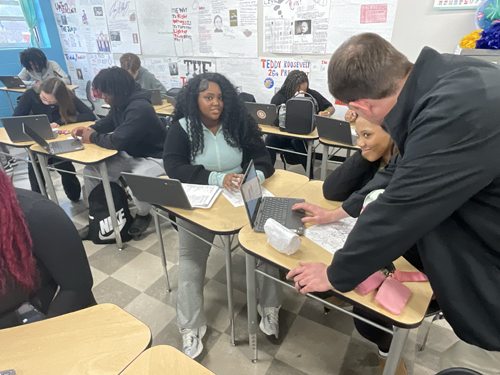
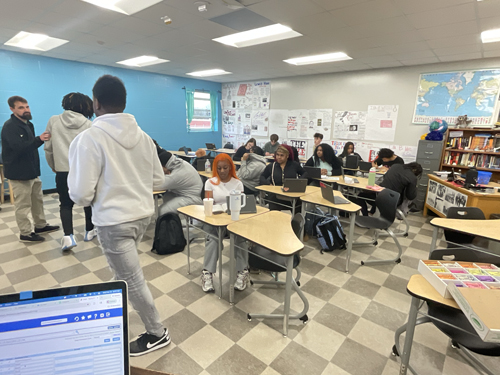
Ingram teaching and helping students
-
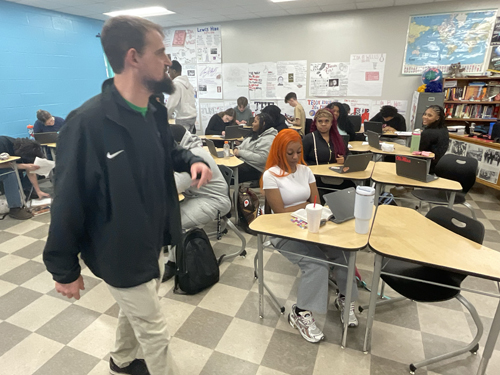
Ingram teaching and helping students
-
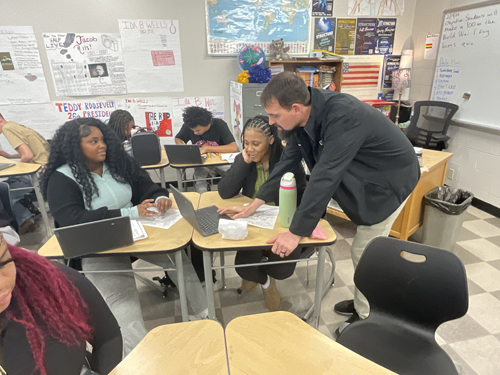
Ingram teaching and helping students
-
Ingram teaching and helping students
-
Ingram teaching and helping students
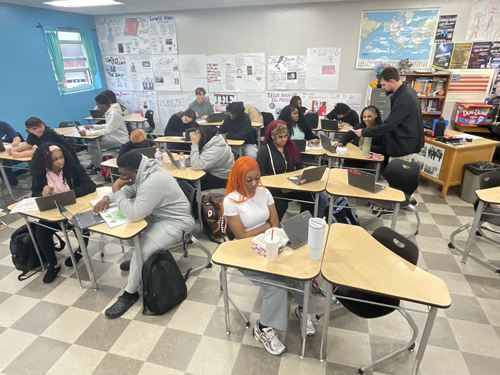

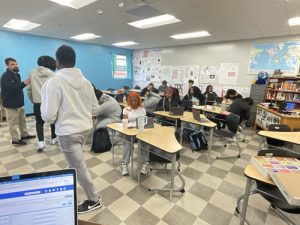
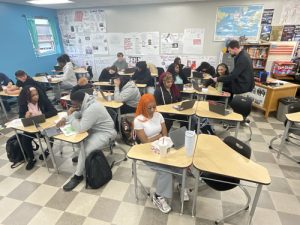
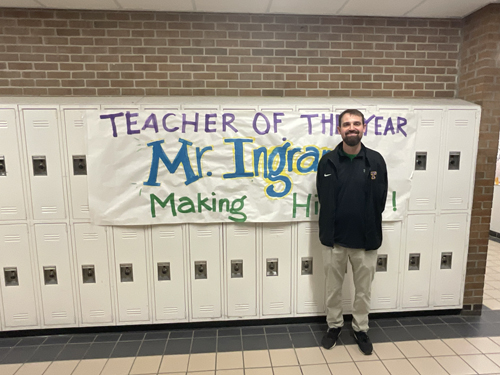
Jordan Williams, Wave Media Managing Editor, sits down with Jamie Ingram, THS Teacher of the Year 2025-2026.
JI: I was lucky enough to win the 2025 Teacher of the Year at Tupelo High School.
WM: How do you feel about receiving this award?
JI: I’m honored. I’m very proud, and as I said, I feel fortunate. There are many other very good teachers at this high school, far, far more deserving of this award than I, so I’m very honored to receive it. Very much.
WM: What are your expectations of your students?
JI: Honestly? I think the expectation varies student by student. Honestly, even though I’m a US History teacher, I would like students to be better human beings when they leave my classroom than when they started, I would like them to treat each other with kindness and respect and basically just understand that they have an important role as a member of society, to be a functioning but also very respectful human being to every other human being that they encounter. That’s honestly what I would love them to take from me; that would be my expectation.
WM: Being Teacher of the Year. Does that change anything for you?
JI: Oh, it’s really nice to be honored. It’s nice to be recognized, but honestly, it doesn’t change my day-to-day approach. I try to still be the same teacher I was five years ago. I do my best at least. No, no, I don’t really think it changes anything. It’s just very nice to be recognized and honored by my peers.
WM: What is your perspective on teaching young teenagers valuable lessons for the future?
JI: Oh, I think that’s probably my most important role, I mentioned earlier. You know, my job, by title, is to teach United States history, and I take that very seriously. But honestly, I think being a teacher, you have the ability to shape young minds, to model really awesome behaviors, to model solid work ethic. And if my students take anything from me, I hope they realize that I put a lot of effort and energy into my job each day, that my work ethic was very high, and that, first and foremost, the way I treated people is what they remember me for. So honestly, I think being a teacher of any subject is very important, but while you’re teaching, you should be modeling the kind of people we want to produce in their adult lives. So, you know, teenagers are very impressionable at the time. You can really leave a mark on a teenager. So I don’t take that lightly. I think that’s probably the most important part of our job.
WM: Has your view of student success changed over the years?
JI: That’s a great question. I would say that’s a complicated answer. But success, I think, could be measured in a number of different ways. For the last eight years, my class was a state-tested course, so one way to measure success was how well students did on the state test. But I think that’s way too shallow to look at success, especially when you’re talking about students. I think success for me would be seeing growth from a student from the first day I meet them in August to the last day I see them in December. I measure success by growth and, really, by my ability to hopefully encourage students to give their all. Yeah, so success really just depends on the student, as long as they’re actively learning and improving themselves. That’s my barometer of success, for sure.
WM: If you could change one thing about the education system, what would it be?
JI: I would say the rise of AI is crippling students’ ability to think critically and analyze even the most basic topics, I would say, because of the reliance on AI, students are even more reliant on their cell phones than they were even a year or two or three years ago, and not for the same reasons. You know, in our classrooms, I think we’re doing a much better job of monitoring cell phone use, but it’s very clear that many students cannot function without their cell phones. And I don’t want to criticize all students. There’s plenty of students who can do perfectly well without a cell phone, but the cell phone and the rise of AI, that would be the scary that’s the scariest thing to me,
WM: What is one of the biggest myths about teaching students you have heard about?
JI: Every classroom is going to be the same. I know that’s probably not even a myth, but people who don’t teach probably have this misunderstanding that, okay, you get your lesson plan together and that’s what you do all day, every day. You do it over and over again. No, each class learns differently. Each class is an organism of its own. It’s a living, breathing thing because of the attitudes and personalities in each class. You might deliver an event or topic in your second block, and it goes wonderfully, and then your fourth block arrives. It’s a different time of the day. It’s made up of different personalities. And you do the exact same thing you did in second block, and it just falls flat. So you have to stay on your feet. You have to be dynamic. You have to be able to kind of adapt on the fly.
WM: How do you effectively bring up the morale of students in your class?
JI: I would hope that they see that I am. I try to be a very positive human being every day. Not do I don’t just bring energy, but I try to keep a smile on my face while I do what I do. And that’s not just, you know, Fridays or Thursdays, that’s Monday through Friday for 36 weeks every year. I try to model their enthusiasm, and my enthusiasm and positivity should serve as a model for them. I hope, I hope that it does okay.
WM: What is one thing you want to introduce to your classroom, specifically next year?
JI: Well, you know, this is going to go against what I said earlier, but I’m also looking at new ways to introduce AI into the classroom in beneficial and collaborative ways. There are many systems out there where we can implement AI and even help you all win arguments against AI bots. I look forward to implementing that in my classroom a lot more next year. I’ve started to play with it a little bit, but at the right time, at the right day, I’m going to really try to implement AI as an arguing force for each and every student.
WM: What is one thing you believe your students don’t realize is important until later on in their life?
JI: The ability to show up to class/work each and every day, the ability to do that with a smile on your face, and the ability to do that with a legitimate work ethic. Not just show up. Show up ready to work, ready to improve on an absolute daily basis and on time every day. I think it’s the basic stuff that we’ve kind of lost sight of. And I know at Tupelo High School we do a good job of emphasizing these basic work and life skills, but seriously, just showing up on time, ready to work with a good attitude every day will really go a long way in whatever you decide to do.
WM: Can you share a story about how you failed to teach a lesson and what you have learned from that experience?
JI: Man, I could tell you a lot of very tragic stories. I taught economics in my first year of teaching. I taught it for 9 weeks, and I think the administration decided I was so bad at teaching economics that they would never let me teach it again. Specific lessons. I tend to talk too much in many of my lectures. I believe in the old-fashioned lecture. A lot of times, I get way too into topics, and we get 20-25 minutes into a lecture, and students are nodding in and out. So I can’t think of one exact lesson, per se, but I still struggle with that. I have to really be mindful of what to say, how to say it. Kind of get in and get out of certain topics when I know that I can, because attention spans are not what they used to be among younger generations.
WM: As a teacher, do you also learn as you teach?
JI: Oh yes, absolutely. Another beauty of being a teacher is that you kind of stay young by default. You spend your life amongst teenagers, and so you learn a lot of new things, a lot of new words, a lot of new behaviors, a lot of new phrases, many of them you wish you did not learn. But it’s actually quite fun. And you know, I’m getting up in my years. I’m only 35, but it seems like yesterday I was 23, just starting in this profession. I feel like teaching has kept me young. Spending my days with teenagers has kind of helped me stay youthful in the way I view the world.
WM: And last question, what caused you to become a teacher?
JI: I had a lot of really good teachers growing up. And I know that sounds cliché, but that’s the truth. I had many teachers who really inspired me. I came across a few teachers and, you know, my schooling journey, and even in my college journey, who weren’t the best, and I think the great teachers really inspired me to be a teacher. But even the poor teachers that I observed showed me how destructive that could be for a student who wants to learn, a student who wants to expand their knowledge base. You have a really important job to help that student out, and you have to understand that every single student who walks into your classroom is an opportunity for you to improve. Let me shout out my first-grade teacher, too. If you asked me, one person who inspired me to teach it was my first-grade teacher at Pierce Street Elementary. Her name was Missy Lunsford, and Miss Lunsford showed me how powerful it is when a good teacher brings real love, care and positive energy into their classroom. She showed me that you can impact every single student that walks into your classroom. And so I would say definitely miss Lunsford. And first grade was a long time ago. A lot of people don’t even remember memories from first grade. I have more memories from her classroom than I do probably from the rest of my childhood combined. So Miss Lunsford, for sure, was the major inspiration for me.